

Free Sustainable Drainage Systems (SuDS) for Nevill residents: part of the residential flood solution for Lewes
Do you live on the Nevill estate? We are offering a free SuDs rain-planter (complete with soil and ready to plant) to Nevill households who’d like to be part of a new project to sustainably manage heavy rainfall in order to reduce surface water flooding in Lewes. The ‘Storing the Storm’ project is run by the Ouse & Adur Rivers Trust, with support from Friends of Lewes, and funded by Lewes District Council. It aims to slow the flow of water entering the surface drains by capturing and storing rainfall.
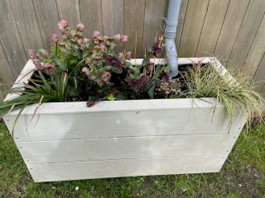
The SuDS storm-planters on offer will be similar to the one shown above.
A quick guide to Sustainable Drainage Systems
The aim of Sustainable urban Drainage Systems (SuDS) is to manage rainfall close to where it falls, by allowing it to soak into the ground via vegetation, slowing the flow of surface water into the drainage system to lessen the risk of drainage and sewer flooding.
Rain-planters are one of the most inexpensive forms of SuDS. Also known as storm-planters or raingardens, these lined boxes are connected to a downpipe to receive and store rainwater from the roof. The planter is filled with layers of soil, sand and gravel which help to store the water and release it slowly through a perforated pipe in the planter base. This water can go back into the drain or simply infiltrate the ground, depending on where the planter is located.
Storm-planters can be safely sited by buildings, garages or sheds and come with many benefits – adding lush vegetation and colour to drives and patios, providing space for pollinators, plus you’ll be contributing to climate adaptation.
The 6 wonders of storm-planters
- Water collection: SuDS rain-planters have their impact right at the start of the rainwater journey. Positioned to collect water from a downpipe they capture rainfall that might otherwise run across hard surfaces like roads and pavements, collecting pollutants and overwhelming the drainage system.
- Filtration: As rainfall enters a rain-planter it passes through a layer of plant roots, soil and sand where pollutants are filtered out, so the water leaving the planter is cleaner.
- Storage: Hidden in the rain-planter’s base is a layer of gravel which stores the water in the spaces between the stones, releasing it slowly back into the environment. It is this slow and delayed release which helps lower the chance of local sewer systems becoming overwhelmed after heavy rain.
- Evapotranspiration: A certain volume of water never makes it out of the rain-planter. Instead, it is taken up by plants and returned to the atmosphere by evapotranspiration.
- Overflow: In extremely heavy storms your SuDS planter may become full. It has a built-in overflow pipe which return the water to the local drainage system.
- Biodiversity: As well as storing rainfall, the rain-planters become microhabitats in themselves, supporting wildlife including birds and insect pollinators.
Why you need a rain-planter
Lewes is a hotspot when it comes to flooding. Whilst some areas are at risk of flooding from the river, a bigger problem comes from the management of surface water, caused by both foul and surface water flooding when the piped drainage system is exceeded.
Unfortunately, evidence suggests that urban flooding will become more frequent due toe intense rainfall associated with climate change, and increasing impermeable surfaces in urban areas. Recognising these issues and starting to manage our own household rainfall more sustainably is one of the ways we can all take a small bit of responsibility and do something positive.
To reserve a planter or just to find out more contact: Rachel Paget at the Ouse & Adur Rivers Trust. Email: rachel.paget@oart.org.uk.
Become a Friend of Lewes
 Friends of Lewes